
An Integrative Physician on Nervous System Regulation and Root-Cause Care
By Dr. Lienna Wilson, Licensed Psychologist | Vagus Vitality

Many patients arrive at their doctor's office with a list of symptoms that don't seem to add up: migraines alongside gut trouble, palpitations next to unexplained rashes, a racing heart no cardiologist can quite account for. For Dr. María del C. Colón-González, a board-certified family physician who founded the integrative primary care practice Salud Revisited in Houston, these seemingly unrelated complaints often trace back to the same source: a nervous system that has lost its balance.
To learn more about this topic, I had the pleasure of interviewing Dr. Colón-González, who blends conventional family medicine with tools like HeartMath biofeedback and Japanese-style medical acupuncture. Her practice is bilingual in English and Spanish, and she works with children, teens, and adults on the root causes of chronic symptoms. I asked her how nervous system regulation fits into that work, where the evidence stands, and what she recommends to someone just getting started.
Nervous System Dysregulation as an Underlying Driver
Dr. Colón-González built Salud Revisited around root-cause, whole-person care, and nervous system regulation sits close to the center of that framework. “Nervous system dysregulation, or an imbalance between the sympathetic and parasympathetic nervous systems, can be associated with musculoskeletal pain, migraines, palpitations, bloating, diarrhea, constipation, and rashes,” she says.
In her experience, this pattern shows up often enough that she looks for it as a matter of course. “Our bodies are designed to seek balance, and that includes the nervous system,” she says. Much of that balance runs through the gut. “We are only beginning to fully understand the brain-gut connection,” she says, “and I believe it is key to explaining many of the symptoms patients present with.”
The gastrointestinal tract has its own nervous system, the enteric nervous system, that researchers sometimes call a second brain, a term popularized by neuroscientist Michael Gershon. It stays in constant contact with the brain, mainly through the vagus nerve, and that back-and-forth reaches well beyond digestion. Disruptions in that signaling have been linked to digestive problems and mood symptoms (Mawe & Hoffman, 2013) as well as inflammation and pain (Tracey, 2002). That two-way communication between the gut and brain, often called the gut-brain axis, has become one of the more active areas of research in medicine (Cryan et al., 2019).
Biofeedback and Heart Rate Variability
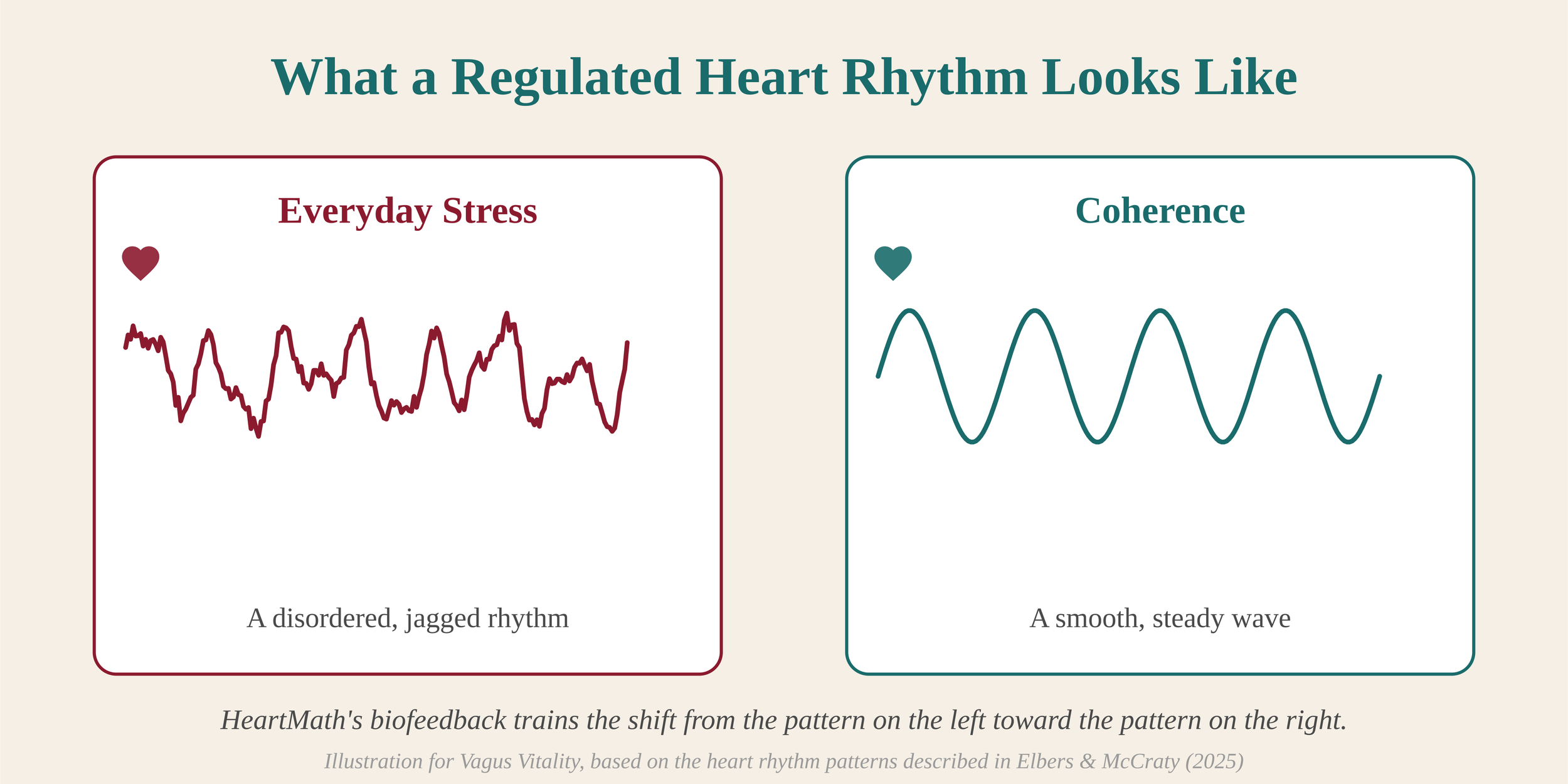
Dr. Colón-González is also trained in HeartMath stress resilience techniques. “HeartMath combines breathing techniques with emotional awareness and uses biofeedback to help patients observe changes in heart rate variability,” she explains. In the moment, this can support emotional and mental well-being as well as clearer thinking, she says.
HeartMath's central concept is something researchers call coherence: a smooth, rhythmic heart rate pattern that emerges when someone slows their breathing to roughly six breaths a minute while deliberately shifting into a calmer emotional state, often by recalling a feeling of appreciation or care.
That pattern looks different from ordinary relaxation. Relaxation tends to produce a low, steady heart rate with reduced variability, while coherence produces a higher, more organized wave of variability that reflects the heart, lungs, and brain synchronizing with one another rather than each drifting on its own rhythm (Elbers & McCraty, 2025). Biofeedback devices display this pattern back to the user in real time, which is what makes it possible to learn, with practice, how to shift into that state on purpose.
“Greater heart rate variability is also associated with stronger stress resilience and overall health,” Dr. Colón-González adds, and the research bears that out from a few different directions. Clinical trials of HeartMath-based coherence training have reported improvements in sleep, fatigue, depression, and stress symptoms among cancer survivors, reductions in pain and negative emotion in veterans with chronic pain, and stress-recovery gains in physicians that were still holding weeks after the training ended (Elbers & McCraty, 2025). Heart rate variability itself is also an independent predictor of broader health outcomes, which is part of why a tool aimed at improving it has drawn interest well beyond stress management alone.
Where Acupuncture Fits In
Dr. Colón-González practices Japanese-style medical acupuncture (Kiiko style), and she sees a direct link between that training and nervous system function. “Certain acupuncture points may help stimulate vagal pathways and support balance within the nervous system,” she says. This can be especially relevant, she notes, for “patients with gastrointestinal dysmotility disorders.” Reviews of the evidence describe a similar picture: acupuncture appears to influence gastrointestinal motility partly through its effects on vagal and other autonomic pathways, though the exact mechanisms are still being mapped in detail (Yang et al., 2025).
The Body Is an Orchestra: Gut, Hormones, and the Nervous System
Chronic stress and gut, hormone, and metabolic imbalances often show up together in Dr. Colón-González's patients, and she sees the nervous system as the thread connecting them. “What happens in the brain affects the gut, and vice versa,” she says. Neurotransmitters and signaling pathways within the gut can influence how well people digest food and how they experience gastrointestinal symptoms, she explains.
Metabolism, in her view, is just as tightly bound to hormones, though she is careful not to let patients oversimplify that relationship. “Patients often think primarily of estrogen, progesterone, and testosterone,” she says, “but the hormonal system is more like an orchestra: all its parts must function and communicate well to create a harmonious result.” Neurotransmitters, in her framing, play a related but different role. “Neurotransmitters are like soloists who step forward briefly to deliver a message,” she says, “helping coordinate moment-to-moment reactions and protective responses.”
Meeting Patients Where They Are: Age and Culture
Dr. Colón-González works with children, teens, and adults, and she says the core approach to nervous system regulation does not change much across age groups. “The essence of the work is the same across age groups,” she says. What shifts is delivery: with pediatric patients, she adapts her approach “to make the techniques more playful, engaging, and interactive.”
Language and culture shape those conversations too. As a bilingual physician serving a large Hispanic and Spanish-speaking patient population, she has learned to read the room differently depending on who is in front of her. “In my experience, many Hispanic patients may express emotions openly, which can be very healthy,” she says. At the same time, she has noticed something more guarded beneath that openness. “There can still be stigma around discussing emotional health concerns or seeking support for emotional well-being,” she says. “Recognizing that cultural context helps me approach these conversations with sensitivity.”
Where to Start: Box Breathing
If someone reading this has never intentionally worked on nervous system regulation before, Dr. Colón-González recommends starting small. “Box breathing is a simple place to begin,” she says: inhale for four counts, hold for four, exhale for four, and hold again for four. Repeat for three to five cycles, adjusting the count if needed for comfort. “You do not need to sit completely still or close your eyes to practice it,” she adds, which makes it something people can fold into an ordinary day rather than treat as a separate ritual. A recent controlled study found that box breathing before a stressful task blunted the usual rise in heart rate and anxiety that followed (McAllister et al., 2026).
For Dr. Colón-González, nervous system regulation is not a separate wellness practice tacked onto primary care. It is woven into how she looks for the root cause of a symptom in the first place, whether that shows up as a stomachache, a migraine, or a patient who feels emotionally shut down. Simple tools like box breathing offer an accessible starting point, but as her work shows, they sit within a much larger picture of how the brain, gut, and hormones stay in conversation with each other.
About
Dr. Colón-González is a board-certified family physician and the founder of Salud Revisited, an integrative primary care practice in Houston, Texas. She earned her medical degree cum laude from the University of Puerto Rico School of Medicine and completed her residency in family and community medicine at Penn State Hershey Medical Center. She is credentialed in Lifestyle Medicine through the American College of Lifestyle Medicine and trained in Japanese-style medical acupuncture, HeartMath stress resilience techniques, and precision genomics. She provides bilingual care in English and Spanish and can be found at saludrevisited.com.
Note: HeartMath biofeedback, medical acupuncture, and the other techniques discussed here are typically offered by a trained clinician as part of a broader care plan. Nothing here is a substitute for individualized medical care. If you are dealing with persistent symptoms, talk to your doctor about what is right for you.
References
Cryan, J. F., O'Riordan, K. J., Cowan, C. S. M., Sandhu, K. V., Bastiaanssen, T. F. S., Boehme, M., ... & Dinan, T. G. (2019). The microbiota-gut-brain axis. Physiological Reviews, 99(4), 1877–2013. https://doi.org/10.1152/physrev.00018.2018
Elbers, J., & McCraty, R. (2025). From dysregulation to coherence: Exploring the HeartMath approach to emotional and physiological regulation. Global Advances in Integrative Medicine and Health. https://doi.org/10.1177/27536130251408821
Mawe, G. M., & Hoffman, J. M. (2013). Serotonin signalling in the gut: Functions, dysfunctions and therapeutic targets. Nature Reviews Gastroenterology & Hepatology, 10(8), 473–486. https://doi.org/10.1038/nrgastro.2013.105
McAllister, M. J., Martaindale, M. H., Sutton, N., & Andersen, J. P. (2026). Box breathing and prolonged exhalation reduces markers of physiological stress reactivity in response to a virtual Trier social stress test. Comprehensive Psychoneuroendocrinology, 27, 100360. https://doi.org/10.1016/j.cpnec.2026.100360
Tracey, K. J. (2002). The inflammatory reflex. Nature, 420(6917), 853–859. https://doi.org/10.1038/nature01321
Yang, N.-N., Xie, X.-X., Yan, W.-L., Liu, Y.-D., Wang, H.-X., Yang, L.-X., & Liu, C.-Z. (2025). The autonomic nervous system in acupuncture for gastrointestinal dysmotility: From anatomical insights to clinical medicine. International Journal of Medical Sciences, 22(11), 2620–2636. https://doi.org/10.7150/ijms.107643