
A Doctor of Chinese Medicine on Acupuncture, Qi, and the Vagus Nerve
By Lienna Wilson, PsyD | Vagus Vitality
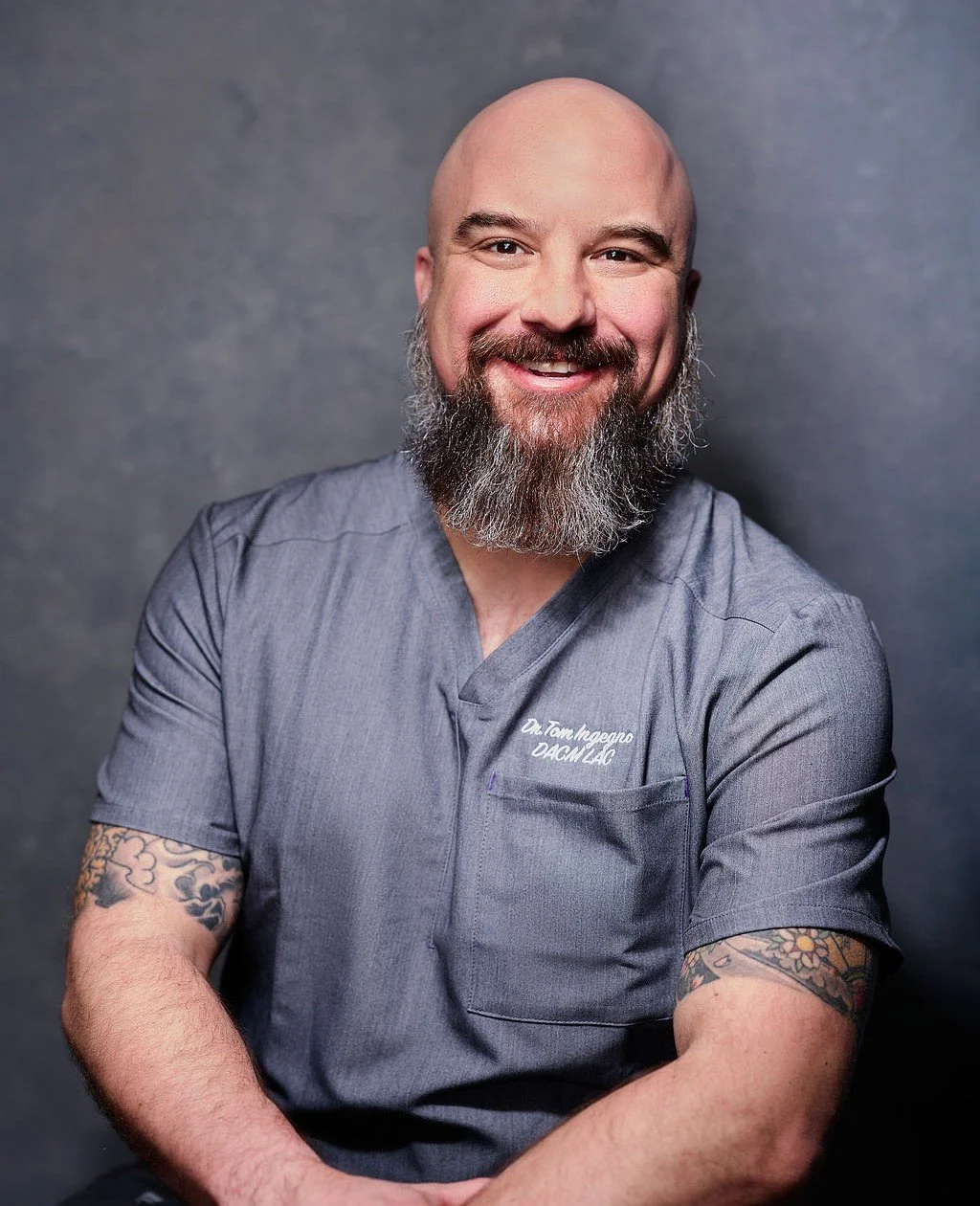
Acupuncture has been treating the nervous system for thousands of years, long before anyone knew what the vagus nerve was. I asked Dr. Tom Ingegno, DACM, MSOM, LAc, founder of Charm City Integrative Health in Baltimore, to help translate between two very different maps of the body: the channel and Qi theory that acupuncturists have relied on for millennia, and the modern physiology that is starting to explain some of what that theory was describing all along. He makes a case against reducing acupuncture, or nervous system regulation in general, to a single mechanism, a single point, or a single hack.
Dr. Tom has more than 25 years of clinical experience in East Asian Medicine and has practiced Tai Chi, Qi Gong, and meditation for over 30 years. He is the author of The Cupping Book and You Got Sick, Now What?, has been featured as an expert in outlets including WebMD, Forbes, USA Today, and The Daily Beast, and regularly lectures on East Asian Medicine and integrative health, including presentations for military healthcare professionals through Walter Reed National Military Medical Center. You can learn more about his practice at www.charmcityintegrative.com.
Two Maps of the Same Body
Most people know the basic mechanics of acupuncture, where fine needles are placed in the body to help correct a health issue, but Dr. Tom starts somewhere older. “The traditional saying is, ‘Where there is flow, there is no pain (dis-ease); where there is no flow, there is pain (dis-ease).’” he says. Classically, restoring energy and blood flow to an area where it was weak or lacking helped restore function, whether the issue was physical, emotional, psychological, or spiritual.
That language, he points out, comes from a medical system that “developed thousands of years before we understood neurotransmitters, hormones, inflammation, or the function of the vagus nerve.” Channel and Qi theories, in his view, were simply an elegant way of describing observable changes in the body using the knowledge and language available at the time.
From a modern perspective, Dr. Tom explains that inserting and stimulating a needle “creates sensory input that travels through peripheral nerves into the spinal cord and brain, where it can influence pain processing, autonomic activity, blood flow, muscle tone, and the release of different neurochemicals.” He does not see these two explanations as competitors. “East Asian Medicine gives us a very sophisticated map based on patterns observed over thousands of years, while modern research is starting to explain some of the physiology underneath those observations.”
Why There Is No Single Vagus Nerve Point
It is tempting to ask which acupuncture point stimulates the vagus nerve, but Dr. Tom says that question reveals a basic difference between East Asian Medicine and what he calls reductionist medical systems. “If you went to your doctor and presented with a list of symptoms, you would likely receive one or more diagnoses and then a drug, therapy, or surgery aimed at each condition,” he says. “East Asian Medicine looks at the person as a whole being and attempts to find a way to balance all of these out.”
That means acupuncture points have multiple functions rather than one narrow job. “There are many points that can affect vagal activity, but there isn’t one point that performs this function,” he says. Research does show shifts in autonomic activity during treatment, including movement toward greater parasympathetic tone, and Dr. Tom describes seeing this play out in his own clinic. “Clinically, after about 10 to 15 minutes of acupuncture treatment, I often start to see patients shift out of a sympathetic state and into a more parasympathetic state, provided I’ve found the right patterns and points for that patient” (He et al., 2012; Cao et al., 2025).
The variability this creates is well known in the field, captured in two Chinese expressions Dr. Tom likes to cite: “Ten acupuncturists, ten treatments,” and the more exaggerated idiom, “One treatment, ten thousand diseases; one disease, ten thousand treatments.” He sees the vagus nerve as central to what he calls the cascade effect of acupuncture, “one of the first dominoes tipped to set a series of system-regulating functions into action.”
A Systems-Level Effect, Not a Single Switch
Ask Dr. Tom how acupuncture reaches beyond the vagus nerve, and he starts listing systems: cardiovascular, immune, neurological, musculoskeletal, and mental health. “Studies have demonstrated effects on immune activity and regulation, hormones and neurotransmitters, endogenous opioids such as endorphins, and the endocannabinoid system,” he says, noting that acupuncture has also been shown to influence serotonin and dopamine pathways (Cui et al., 2021; Li et al., 2022; Li et al., 2021; Longhurst, 2013).
“When you start looking at all of these effects together, you begin to see why I don’t think it makes sense to reduce acupuncture to simply stimulating the vagus nerve,” he says. Neurological, endocrine, immune, and autonomic systems all communicate with one another, and in his view acupuncture appears to affect this larger regulatory network rather than flipping one isolated switch. He also points to overlap between brain activity during acupuncture and what happens during deep relaxation and meditative states. “Clinically, this seems to show the patient what a relaxed, balanced state feels like. With repeated treatments, many of my patients report being able to enter that state more easily on their own, supporting the body’s ability to regulate and heal.”
As for Qi stagnation, the traditional explanation for pain that many patients ask about, Dr. Tom is careful with the term. “Qi stagnation, as it’s understood in East Asian Medicine, is a blockage of energy that often leads to pain or discomfort in an area,” he says, “but saying ‘Qi stagnation’ doesn’t tell us where or why the Qi is stuck, nor the underlying reasons it became stuck in the first place. That’s where the rest of our diagnostic system comes in.”
Tai Chi and Qi Gong: Practicing What Acupuncture Shows You
Dr. Tom has practiced Tai Chi, Qi Gong, and meditation since 1995, and he sees them as a natural complement to acupuncture rather than a substitute for it. These moving meditation practices, he explains, developed within a broader Daoist framework focused on balance and moderation, one that shaped far more than medicine. “Yes, that includes Tai Chi, Qi Gong, and meditation, but you can also see them in music composition, flower arranging, poetry, calligraphy, and Feng Shui.”
The practice itself asks for a demanding kind of attention. “Our aim is awareness of our body’s position in space, structural alignment, breath, the movement itself, and the surrounding environment, all while trying to relax,” he says. “Shifting to a general awareness while moving slowly and intentionally forces our mind to slow down and concentrate, allowing us to better regulate our internal environment and ‘flip the switch’ from fight-or-flight to rest-and-digest. You’re essentially practicing being attentive without being hypervigilant.”
The difference between the two therapies, in Dr. Tom’s telling, comes down to whether the patient is active or passive. “Acupuncture is different because it’s largely passive. You can lie on the table and let the treatment provide that sensory input. Tai Chi and Qi Gong are active practices. You’re developing the ability to notice your state and influence it yourself.” He views them as complementary tools: “Acupuncture can help show the nervous system what a quieter state feels like. Tai Chi and Qi Gong give you tools to practice finding that state on your own.” Patients who already practice meditation, Tai Chi, or Qi Gong, he adds, tend to report more noticeable and pleasant sensations during treatment, including warmth, movement, tingling, and heaviness, even when they “don’t know how to describe it.”
What a First Visit Actually Looks Like
For someone dealing with chronic stress, anxiety, or burnout, Dr. Tom is upfront that acupuncture is not a quick fix. “It is a therapy, and a treatment plan should be developed and modified based on how the patient responds and the severity of the condition,” he says. The first session starts with listening in a broad sense, including “palpation and pulse-taking,” looking for signs across systems that might seem unrelated on their own but make sense once the patient is viewed as a whole being.
Two patients with similar complaints, such as disturbed sleep, low mood, low energy, weight changes, and brain fog, may be treated very differently depending on which patterns and channels are most affected. The clearest sign that a treatment is working, Dr. Tom says, is relaxation. “As the patient shifts toward parasympathetic activity during acupuncture, they may feel heavy, floaty, or simply fall asleep.” Many people describe something close to a hypnagogic state, somewhere between asleep and awake, and can leave feeling refreshed or a little groggy, both of which he considers normal responses. Sessions themselves typically run somewhere between 15 minutes and an hour, depending on the style of acupuncture and the goal of the visit.
The Vagus Nerve Is Not the Whole Story
Asked about the biggest misconception people bring to him, Dr. Tom does not hesitate. “I think one of the biggest misconceptions is our tendency to reduce acupuncture down to a single mechanism. Right now the vagus nerve is having its moment, so everything seems to be about ‘stimulating the vagus nerve.’ Before that, it was endorphins. If we discover another mechanism tomorrow, I’m sure someone will say that’s how acupuncture ‘really works.’” In his view, acupuncture creates a cascade of effects across multiple systems at once, and while the vagus nerve plays an important role in that cascade, “it isn’t the entire process.”
He is equally cautious about assuming modern physiology has finally explained the older framework. “I’m not sure that’s true either,” he says. “East Asian Medicine developed an entirely different framework for observing the body. We don’t have to force Qi, channels, Shen, Blood, Jing, and every other traditional concept into a Western medical equivalent for them to be useful.” After nearly 25 years in practice, what interests him most is the overlap between the two systems rather than a verdict on which one was right. “For me, the exciting part isn’t proving that one system was right and the other was wrong. It’s realizing that we may be looking at the same human body from two very different perspectives.”
Nervous System Regulation at Home: The Idea of Yang Sheng

When it comes to practices people can try on their own, Dr. Tom reaches for a concept called Yang Sheng, usually translated as “nourishing life.” “The basic idea is incredibly simple: what you do every day matters. How you sleep, eat, move, breathe, work, rest, and interact with the world around you all have an effect on your health.”
He is wary, though, of how self-care has been marketed. “At some point, we have to acknowledge that you can’t self-care your way out of burnout,” he says. Piling a “5 a.m. meditation, cold plunge, elaborate supplement routine, and three more things you’re supposed to accomplish before breakfast” onto an already overworked, underslept, overstimulated life “may actually be missing the point.” He is similarly skeptical of what he calls “Chinamaxxing,” a trend he sees online that reduces Chinese medicine and culture to a checklist of wellness hacks. “Drink this tea. Scrape your tongue. Do Qi Gong. Eat congee. Use a gua sha tool. Go to acupuncture. Any of those things might be perfectly healthy, but checking enough Chinese wellness practices off a list isn’t how we maintain balance.”
Yang Sheng, as Dr. Tom describes it, is closer to the opposite instinct: “paying attention to what your body and your life actually need and trying not to live continually at either extreme.” His suggestions for getting started are deliberately small. “Take a few slow breaths before you get out of your car. Go outside and walk for ten minutes. Put your phone down while you eat. Stretch when you’ve been sitting too long. Spend a few minutes doing something you actually enjoy without trying to make it productive.” Even his own practices, he says, don’t need to become another obligation: “A few minutes of slow, intentional movement or quiet breathing that you actually do every day is more useful than an elaborate practice you do twice and abandon.”
For people who want something more structured, Dr. Tom often recommends Emotional Freedom Techniques, or EFT, sometimes called tapping. “EFT has its roots in acupuncture theory, but instead of inserting needles, you repeatedly tap on a series of acupuncture points while focusing on a thought, feeling, or issue you’re working through.” He describes it as “an interesting bridge between East Asian Medicine and modern mind-body approaches,” useful for people who find it easier to regulate through a physical action than through sitting still with their thoughts.
Dr. Tom is also clear that regulation does not always mean seeking calm. “Exercise, laughing, singing, dancing, being outside, spending time with people you like, making art, or doing something that completely absorbs your attention can all change your state,” he says. “Nervous system regulation doesn’t mean trying to stay relaxed all day. We need sympathetic activation. If a tiger is chasing you, I absolutely want your fight-or-flight response working.” The problem, as he puts it, is when your nervous system starts treating “your inbox, traffic, a difficult conversation, and the tiger as roughly the same emergency.” The goal, he says, “isn’t to eliminate stress. It’s to develop the flexibility to respond when something actually requires a response and then come back down when it doesn’t.”
About Dr. Tom Ingegno
Dr. Tom Ingegno, DACM, MSOM, LAc, is a Doctor of Acupuncture and Chinese Medicine and the founder of Charm City Integrative Health in Baltimore, Maryland. He has more than 25 years of clinical experience in East Asian Medicine and has practiced Tai Chi, Qi Gong, and meditation for over 30 years. Dr. Tom is the author of The Cupping Book and You Got Sick, Now What? and has been featured as an expert in outlets including WebMD, Forbes, USA Today, and The Daily Beast. He regularly lectures on East Asian Medicine and integrative health, including presentations for military healthcare professionals through Walter Reed National Military Medical Center. Learn more at www.charmcityintegrative.com.
Note: This interview reflects the general clinical perspective of Dr. Ingegno and is intended for education, not as a substitute for individualized medical or acupuncture care. If you are considering acupuncture for a specific condition, please consult a licensed practitioner.
References
Cao, L.-L., Liu, H.-R., Ji, Y.-J., Zhang, Y.-T., Wang, B.-Q., Xue, X.-H., Wang, P., Luo, Z.-H., & Wu, H.-G. (2025). Research progress of vagal nerve regulation mechanism in acupuncture treatment of atrial fibrillation. Chinese Journal of Integrative Medicine, 31(3), 281–288. https://doi.org/10.1007/s11655-024-3660-5
Cui, J., Song, W., Jin, Y., Xu, H., Fan, K., Lin, D., Hao, Z., & Lin, J. (2021). Research progress on the mechanism of the acupuncture regulating neuro-endocrine-immune network system. Veterinary Sciences, 8(8), Article 149. https://doi.org/10.3390/vetsci8080149
He, W., Wang, X., Shi, H., Shang, H., Li, L., Jing, X., & Zhu, B. (2012). Auricular acupuncture and vagal regulation. Evidence-Based Complementary and Alternative Medicine, 2012, Article 786839. https://doi.org/10.1155/2012/786839
Li, N., Guo, Y., Gong, Y., Zhang, Y., Fan, W., Yao, K., Chen, Z., Dou, B., Lin, X., Chen, B., Chen, Z., Xu, Z., & Lyu, Z. (2021). The anti-inflammatory actions and mechanisms of acupuncture from acupoint to target organs via neuro-immune regulation. Journal of Inflammation Research, 14, 7191–7224. https://doi.org/10.2147/JIR.S341581
Li, Y.-W., Li, W., Wang, S.-T., Gong, Y.-N., Dou, B.-M., Lyu, Z.-X., Ulloa, L., Wang, S.-J., Xu, Z.-F., & Guo, Y. (2022). The autonomic nervous system: A potential link to the efficacy of acupuncture. Frontiers in Neuroscience, 16, Article 1038945. https://doi.org/10.3389/fnins.2022.1038945
Longhurst, J. (2013). Acupuncture's cardiovascular actions: A mechanistic perspective. Medical Acupuncture, 25(2), 101–113. https://doi.org/10.1089/acu.2013.0960