
The Gut-Brain Connection: How the Vagus Nerve Connects Digestion, Mood, and Health
By Dr. Lienna Wilson, Licensed Psychologist | Vagus Vitality

Think about the last time you were nervous before something important. Maybe a presentation, a difficult conversation, a medical appointment. You probably felt it in your stomach first: that hollow, fluttery sensation that arrives before your conscious mind has fully registered the threat. Or think about grief, how it can take away your appetite entirely, or anxiety that makes you feel genuinely sick to your stomach.
We call these things "gut feelings" as though they're metaphors. They're not. There is a literal, physical communication system running between your gut and your brain, and the main cable carrying those signals is the vagus nerve. Understanding how this system works doesn't just satisfy curiosity. It changes how you interpret your own body, and it opens up real, evidence-based ways to support both your mental and digestive health at the same time.
Your Gut Has Its Own Nervous System
Most people are surprised to learn that the gastrointestinal tract contains approximately 500 million neurons, a number so large that neuroscientist Michael Gershon, in his landmark 1998 book The Second Brain, argued it deserved recognition as a nervous system in its own right. The enteric nervous system (ENS) lines the entire length of the digestive tract, from the esophagus to the rectum, embedded in the walls of the gut in two thin layers of neural tissue.
What makes the ENS remarkable is that it can function independently of the brain and spinal cord. It coordinates the muscular contractions that move food through the digestive tract, regulates secretions, responds to pathogens, and manages local blood flow, all without waiting for instructions from above. This is why people who have suffered spinal cord injuries can still digest food. The gut doesn't need the brain to run its basic operations.
But the enteric nervous system is not isolated. It is in constant, active communication with the central nervous system, and the primary channel for that communication is the vagus nerve (Bonaz et al., 2018).
The Vagus Nerve: Anatomy of a Highway
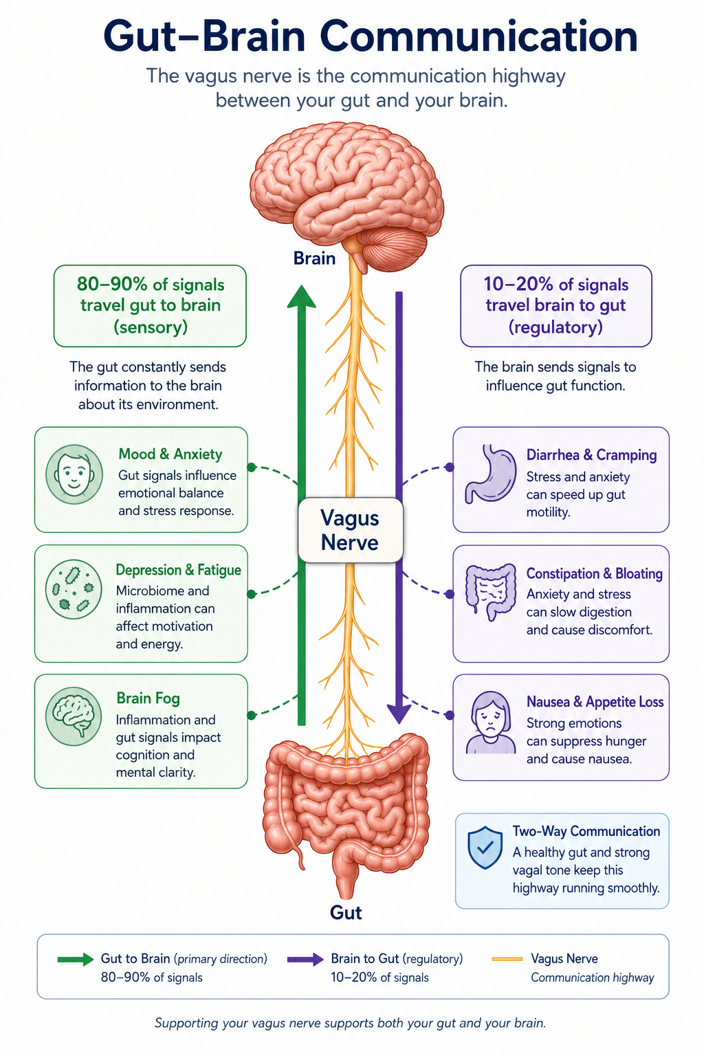
The vagus nerve is the longest cranial nerve in the body. It originates in the brainstem and travels downward through the neck, chest, and abdomen, branching extensively to reach the heart, lungs, liver, spleen, kidneys, and the entire gastrointestinal tract. Its name comes from the Latin word for "wandering," which is apt. No other nerve in the body covers this much territory.
What most people don't realize is the direction of traffic on this highway.
It is commonly assumed that the vagus nerve is primarily a top-down system: the brain sends signals to the organs and they respond accordingly. In reality, the research suggests the opposite is more accurate. Approximately 80 to 90 percent of the nerve fibers in the vagus nerve are afferent, meaning they carry signals upward, from the gut and other organs to the brain, not the other way around (Bonaz et al., 2018). The gut is not passively receiving instructions. It is actively reporting to the brain, continuously, with information about the internal environment of the body.
This has profound implications for how we think about mood, anxiety, and mental health. The brain's perception of how we feel, whether safe or threatened, calm or anxious, well or unwell, is shaped in large part by what the gut is telling it.
What the Gut Is Actually Telling Your Brain
The signals traveling up the vagus nerve carry information about several systems that directly influence brain function and emotional state.
Serotonin
Most people know serotonin as a "mood chemical" produced in the brain. What is less widely known is that approximately 90 to 95 percent of the body's serotonin is produced in the gut, by specialized cells lining the intestinal wall (Yano et al., 2015). Gut-derived serotonin does not cross the blood-brain barrier, so it does not travel to the brain. However, it plays a critical role in gut motility and intestinal function, and it communicates with vagal nerve endings in the gut wall. Disruptions in gut serotonin signaling are associated with conditions like irritable bowel syndrome (IBS), and emerging research suggests connections to mood dysregulation as well (Mawe & Hoffman, 2013).
The Microbiome and Neurotransmitter Production
The trillions of bacteria that make up the gut microbiome are not passive passengers. They produce neurotransmitters and signaling compounds, including GABA, dopamine precursors, and short-chain fatty acids, that interact with the nerve endings lining the gut wall (Cryan et al., 2019). A healthy, diverse microbiome generates a steady stream of signaling molecules that travel via the vagus nerve to influence brain function. A disrupted microbiome, from chronic stress, poor diet, antibiotic use, or illness, alters this signaling and has been associated with anxiety, depression, and cognitive changes in both animal models and human studies (Cryan et al., 2019).
Inflammation
The vagus nerve plays a central role in regulating inflammation throughout the body through what is known as the inflammatory reflex. When immune cells in the gut detect pathogens or tissue damage, they release inflammatory signals. The vagus nerve detects these signals and relays them to the brain, which responds by activating anti-inflammatory pathways through the same nerve (Tracey, 2002). When vagal tone is low, meaning the vagus nerve is not functioning optimally, this anti-inflammatory response is blunted. Chronic low-grade gut inflammation can persist longer and signal more intensely to the brain, contributing to brain inflammation that researchers are increasingly linking to depression, anxiety, and cognitive decline (Miller & Raison, 2016).
When the Highway Breaks Down
Vagal tone refers to the activity level of the vagus nerve: how efficiently it is conducting signals and regulating the systems it connects. Low vagal tone is associated with a range of physical and mental health challenges, and its effects on the gut-brain axis are particularly significant.
When vagal tone is reduced, the bidirectional communication between gut and brain becomes dysregulated. The brain may receive amplified distress signals from the gut, interpreting normal digestive sensations as threatening. This is a phenomenon well-documented in IBS, where heightened gut sensitivity causes ordinary digestive activity to register as pain (Mayer et al., 2015). At the same time, the gut loses some of its downward regulatory signals from the brain, which can affect motility, secretion, and immune function in the intestinal lining.
This creates a vicious cycle that will be familiar to anyone who has experienced anxiety-related digestive symptoms. Stress reduces vagal tone. Reduced vagal tone impairs gut function. A struggling gut sends more distress signals upward. The brain becomes more anxious. Anxiety further reduces vagal tone. And so it continues.
As a psychologist who has treated anxiety throughout my entire career, I have seen this loop play out clinically more times than I can count. The gut symptoms are not imagined, and they are not separate from the anxiety. They are part of the same dysregulated system. Treating one without attending to the other is working with half the picture.
It is also worth noting that the gut-brain connection runs through the vagus nerve in both directions, which means that gut health has a measurable impact on mental health outcomes. Research has found that patients with inflammatory bowel disease have significantly elevated rates of anxiety and depression (Graff et al., 2009), and that gut microbiome interventions, including specific probiotic strains, can influence mood and stress responses in humans (Cryan et al., 2019).
How to Support the Gut-Brain Connection
Because the vagus nerve is the primary communication line between gut and brain, practices that strengthen vagal tone improve the entire system. Vagal tone responds to consistent, lifestyle-level inputs. The most well-researched include slow diaphragmatic breathing, cold water exposure, humming or chanting, regular meditation, time in natural environments, and targeted devices that deliver vibration to accessible branches of the vagus nerve.
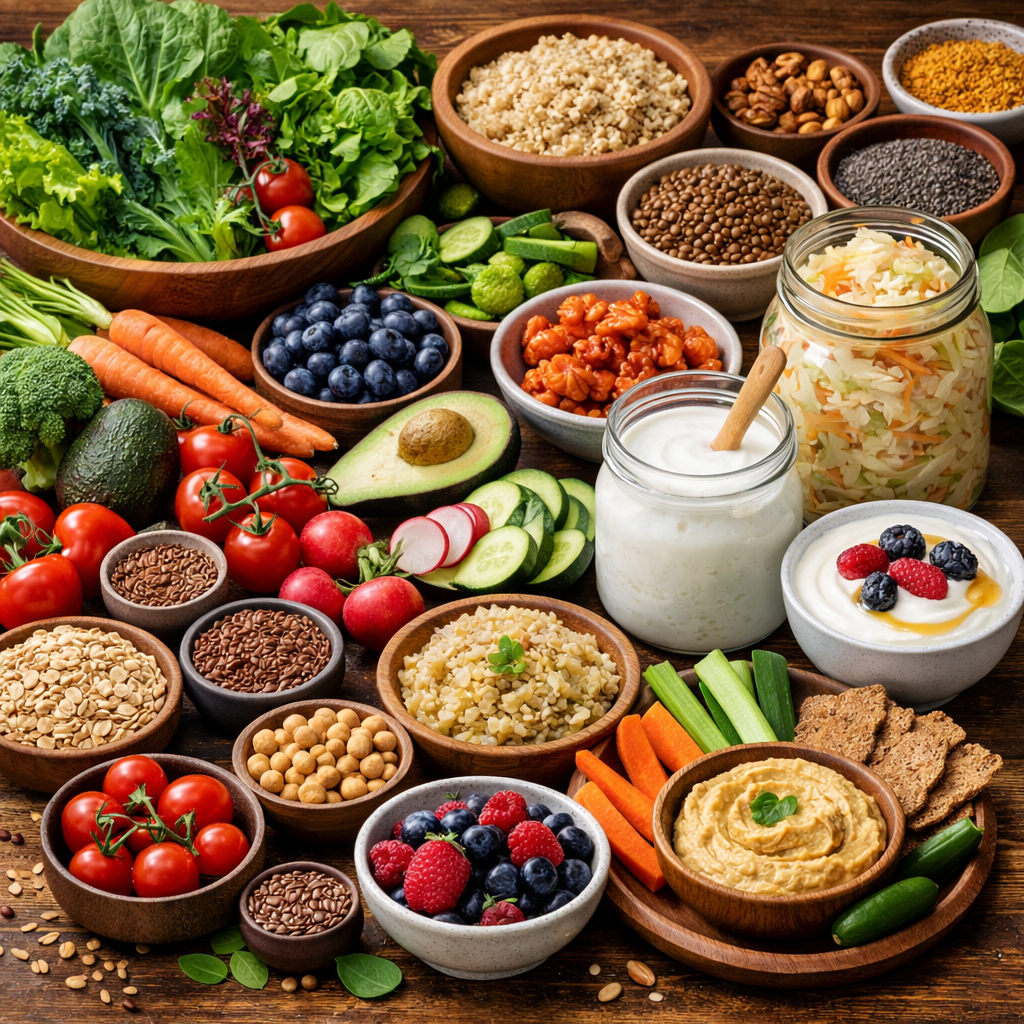
The gut side of the equation matters too. A diverse microbiome, one with a wide variety of bacterial species, generates a richer stream of the signaling compounds described above. The research consistently points to a few inputs that support microbial diversity: a diet high in varied plant foods and fiber, fermented foods such as yogurt, kefir, and sauerkraut when well-tolerated, and limiting antibiotic use to situations where it is genuinely necessary (Cryan et al., 2019). Stress management belongs on this list as well. Chronic psychological stress measurably alters the composition of the gut microbiome, which is one more reason the feedback loop between the brain and the gut runs in both directions (Cryan et al., 2019).
For a detailed breakdown of each method, including practical protocols and what the research actually shows, see How to Activate Your Vagus Nerve: A Science-Backed Guide to Every Method.
The Bottom Line
The gut feelings you have always trusted are real. They travel upward through one of the most significant nerves in your body, carrying information from an intelligent, sophisticated nervous system that has been monitoring your internal world all day long.
The vagus nerve is not just a calming switch you can flip when you feel anxious. It is the primary communication line between two nervous systems that are constantly in conversation, shaping your mood, your immune response, your digestive health, and your capacity to feel safe in your own body. Caring for your vagal tone is not a wellness trend. It is foundational nervous system hygiene.
The practices that activate the vagus nerve, including breathwork, cold exposure, movement, stillness, and time in nature, are not separate tools for separate problems. They are inputs into a single, integrated system. And when that system is working well, the communication highway between your gut and your brain runs clearly, quietly, and in your favor.
Clinical References
Bonaz, B., Bazin, T., & Pellissier, S. (2018). The vagus nerve at the interface of the microbiota-gut-brain axis. Frontiers in Neuroscience, 12, 49. https://doi.org/10.3389/fnins.2018.00049
Cryan, J. F., O'Riordan, K. J., Cowan, C. S. M., Sandhu, K. V., Bastiaanssen, T. F. S., Boehme, M., ... & Dinan, T. G. (2019). The microbiota-gut-brain axis. Physiological Reviews, 99(4), 1877-2013. https://doi.org/10.1152/physrev.00018.2018
Graff, L. A., Walker, J. R., & Bernstein, C. N. (2009). Depression and anxiety in inflammatory bowel disease: a review of comorbidity and management. Inflammatory Bowel Diseases, 15(7), 1105-1118. https://doi.org/10.1002/ibd.20873
Hallihan, C., & Siegle, G. J. (2022). Effect of vibroacoustic stimulation on athletes recovering from exercise. European Journal of Applied Physiology, 122(11), 2427-2435. https://doi.org/10.1007/s00421-022-05026-x
Inbaraj, G., Rao, R. M., Ram, A., Bayari, S. K., Belur, S., Prathyusha, P. V., Sathyaprabha, T. N., & Udupa, K. (2022). Immediate effects of OM chanting on heart rate variability measures compared between experienced and inexperienced yoga practitioners. International Journal of Yoga, 15(1), 52-58. https://doi.org/10.4103/ijoy.ijoy_141_21
Kok, B. E., Coffey, K. A., Cohn, M. A., Catalino, L. I., Vacharkulksemsuk, T., Algoe, S. B., ... & Fredrickson, B. L. (2013). How positive emotions build physical health: perceived positive social connections account for the upward spiral between positive emotions and vagal tone. Psychological Science, 24(7), 1123-1132. https://doi.org/10.1177/0956797612470827
Lehrer, P. M., & Gevirtz, R. (2014). Heart rate variability biofeedback: how and why does it work? Frontiers in Psychology, 5, 756. https://doi.org/10.3389/fpsyg.2014.00756
Mayer, E. A., Labus, J. S., Tillisch, K., Cole, S. W., & Baldi, P. (2015). Towards a systems view of IBS. Nature Reviews Gastroenterology & Hepatology, 12(10), 592-605. https://doi.org/10.1038/nrgastro.2015.121
Mawe, G. M., & Hoffman, J. M. (2013). Serotonin signalling in the gut: functions, dysfunctions and therapeutic targets. Nature Reviews Gastroenterology & Hepatology, 10(8), 473-486. https://doi.org/10.1038/nrgastro.2013.105
Miller, A. H., & Raison, C. L. (2016). The role of inflammation in depression: from evolutionary imperative to modern treatment target. Nature Reviews Immunology, 16(1), 22-34. https://doi.org/10.1038/nri.2015.5