
What Is the Vagus Nerve? A Plain-Language Introduction
By Dr. Lienna Wilson, Licensed Psychologist | Vagus Vitality

You have probably heard the phrase “listen to your gut.” It turns out that is not just a metaphor. Your gut and brain are in constant two-way conversation, and the primary cable running between them is a single nerve called the vagus nerve. It also connects to your heart, lungs, liver, kidneys, and immune system. When this system is working well, you tend to feel calmer, more resilient, and better able to recover from life's challenges. When it is not functioning optimally, the effects can show up in many different ways, including digestive issues, sleep problems, chronic stress, anxiety, and difficulty bouncing back from illness.
As a psychologist, I became interested in the vagus nerve because it sits at the intersection of physical and mental health. Many symptoms that appear psychological also have a physiological component. Anxiety affects digestion. Chronic stress affects sleep. Inflammation can influence mood. The vagus nerve helps connect these systems.
Understanding how this nerve works gives you a practical framework for understanding your health and a clearer picture of why practices such as breathwork, meditation, exercise, and certain medical devices can have meaningful effects on wellbeing.
What Is the Vagus Nerve?
Vagus in Latin comes from the word “wandering,” which is fitting: the vagus nerve travels farther through the body than any other cranial nerve, branching down from the brain through the neck, chest, and abdomen to reach most of your major organs (Cryan et al., 2019). This wide reach is exactly what makes it so central to whole-body health.
One surprising fact is that the vagus nerve is not simply sending commands downward from the brain. About 80% of its fibers carry information up, from the body to the brain, and only the remaining 20% carry signals back down (Cryan et al., 2019).
This means your body is constantly reporting to your brain: the state of your gut, the rhythm of your heart, the tension in your organs. Your brain uses that stream of information to shape your emotional state, your sense of safety, your energy levels, and your behavior, often before you are consciously aware of it. That upward flow is why gut discomfort can affect your mood, why calming your body through breath or movement can shift your mental state within minutes, and why the communication between these systems is genuinely bidirectional.
The Vagus Nerve and Your Nervous System
Your nervous system has two broad operating modes. The sympathetic system prepares you for action and potential danger, and is also called “fight or flight”. The parasympathetic system helps you recover, digest, repair, and rest. The vagus nerve is the primary pathway of that recovery system.
When your vagus nerve is active, your heart rate slows, digestion functions more efficiently, inflammation is better regulated, and your body shifts into a state that supports healing and restoration.
The challenge is that modern life often keeps us in a prolonged state of stress. Deadlines, financial concerns, relationship difficulties, health worries, and constant digital stimulation can repeatedly activate the body's stress response. The vagus nerve is your physiological off-switch for that state.
What the Vagus Nerve Controls
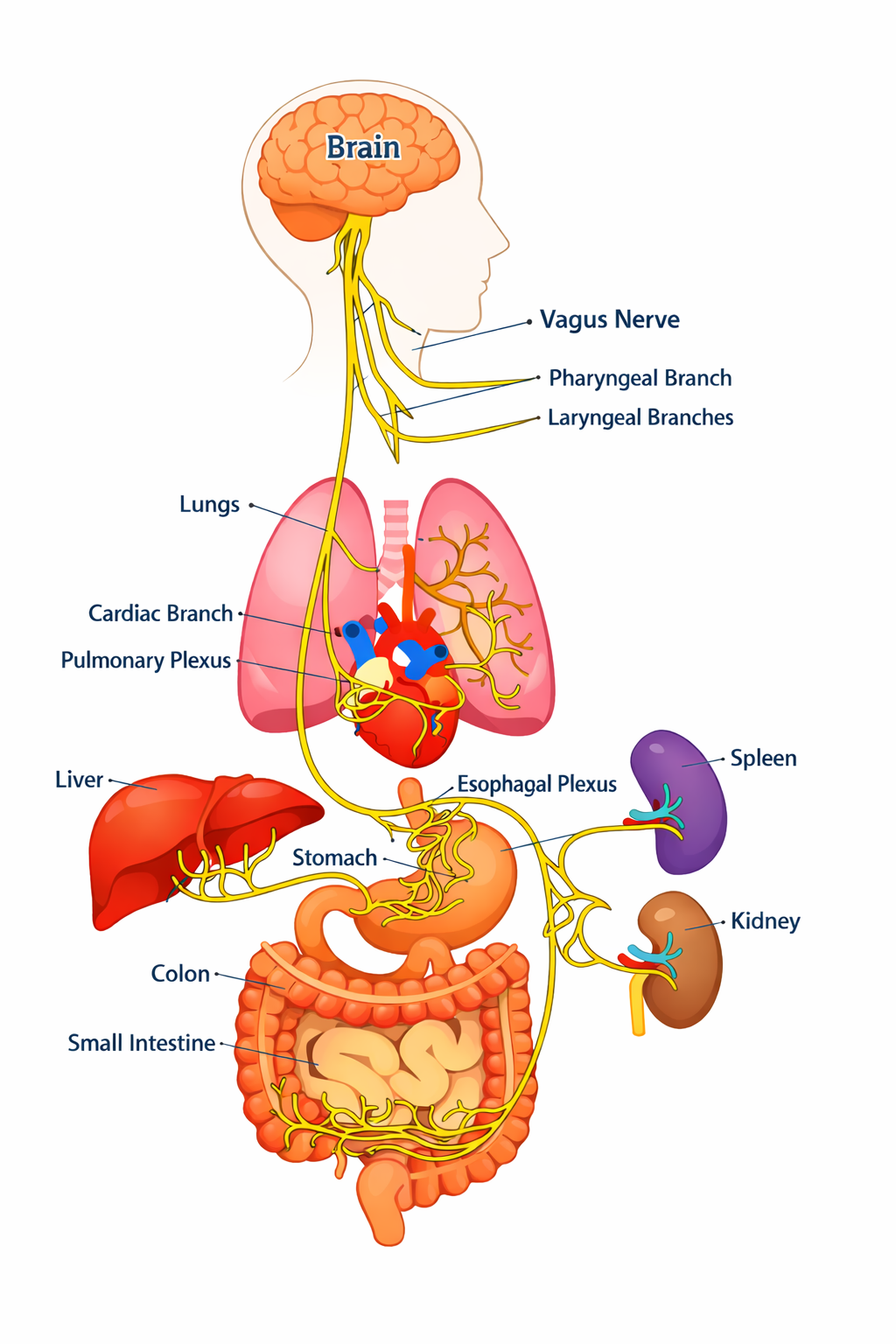
Here are the major systems that the vagus nerve influences:
Heart: The vagus nerve slows the heart rate and helps regulate blood pressure. Its influence on heart rate variability (HRV) is one of the clearest windows into vagal health (Kok et al., 2013; Lehrer & Gevirtz, 2014).
Lungs: Slow, diaphragmatic breathing activates the vagus nerve, which is why deliberate breathwork is one of the most effective tools for shifting into a calmer state (Lehrer & Gevirtz, 2014).
Gut: The vagus nerve is the primary channel through which the gut and brain communicate. It governs the muscle contractions that move food through your stomach, digestive enzyme secretion, and gut lining health. This connection is explored in depth in The Gut-Brain Connection: How the Vagus Nerve Connects Digestion, Mood, and Health.
Immune system: The vagus nerve plays a direct role in regulating inflammation through a circuit sometimes called the inflammatory reflex (Tracey, 2002).
Mood and memory: The vagus nerve is used clinically as a treatment for treatment-resistant depression and anxiety. It also appears to play a role in memory consolidation (Tracey, 2002; Cryan et al., 2019).
Signs Your Vagal Tone May Be Low
Vagal tone refers to the ongoing activity level of the vagus nerve. High vagal tone is associated with flexibility and resilience: a more stable mood, efficient digestion, better sleep, and faster recovery from stress (Lehrer & Gevirtz, 2014; Kok et al., 2013). Low vagal tone is associated with the opposite: poor emotional regulation, chronic inflammation, digestive issues, and difficulty bouncing back from stress or illness.
Low vagal tone does not announce itself with a dramatic diagnosis. It tends to show up as a cluster of things many people have accepted as normal:
Difficulty calming down after stress
Digestive sluggishness or irregularity
Chronic low-grade inflammation
Poor sleep quality
A tendency toward anxiety or depression
Fatigue that does not resolve with rest
Getting sick often, or taking a long time to recover
None of these symptoms alone confirm low vagal tone. But if several resonate, and you have never thought about your nervous system as something that can be trained, that is a useful place to start.
How to Strengthen Your Vagus Nerve
Vagal tone responds to consistent, lifestyle-level inputs. The most well-researched include slow diaphragmatic breathing, cold water exposure, humming or chanting, regular meditation, time in natural environments, and targeted devices that deliver vibration to accessible branches of the vagus nerve.
For a detailed breakdown of each method, including practical protocols and what the research actually shows, see How to Activate Your Vagus Nerve: A Science-Backed Guide to Every Method.
Why This Nerve Is Worth Understanding
The vagus nerve sits at the intersection of everything that matters in nervous system health: stress regulation, immune balance, digestion, mood, sleep, memory, and social connection. As a psychologist, I find it particularly compelling because it helps explain something I see constantly in clinical work: anxiety rarely stays confined to thoughts. It shows up as muscle tension, digestive discomfort, changes in breathing, sleep disruption, or a racing heart. Many people experience these physical symptoms before they consciously recognize that they are stressed.
The vagus nerve is one of the systems that helps explain why mind and body are so interconnected, and why practices like breathwork, meditation, and cold exposure actually work, not as wellness trends, but as targeted inputs into a measurable system. Improving vagal tone is not a standalone treatment for anxiety or depression, but it may support many of the physiological processes involved in emotional regulation and stress recovery.
Researchers are still uncovering how central this nerve is to everything from autoimmune disease to mental health to gut disorders, which makes it one of the more exciting areas in health science right now. Understanding it gives you a useful framework for your own health and a concrete target for the habits and tools you invest in.
References
Cryan, J. F., O'Riordan, K. J., Cowan, C. S. M., Sandhu, K. V., Bastiaanssen, T. F. S., Boehme, M., ... Dinan, T. G. (2019). The microbiota-gut-brain axis. Physiological Reviews, 99(4), 1877-2013. https://doi.org/10.1152/physrev.00018.2018
Kok, B. E., Coffey, K. A., Cohn, M. A., Catalino, L. I., Vacharkulksemsuk, T., Algoe, S. B., Brantley, M., & Fredrickson, B. L. (2013). How positive emotions build physical health: Perceived positive social connections account for the upward spiral between positive emotions and vagal tone. Psychological Science, 24(7), 1123–1132. https://doi.org/10.1177/0956797612470827
Lehrer, P. M., & Gevirtz, R. (2014). Heart rate variability biofeedback: How and why does it work? Frontiers in Psychology, 5, 756. https://doi.org/10.3389/fpsyg.2014.00756
Tracey, K. J. (2002). The inflammatory reflex. Nature, 420(6917), 853–859. https://doi.org/10.1038/nature01321