
Hoolest VeRelief Prime Review: An Assessment From a Psychologist Who Returned It
By Dr. Lienna Wilson, Licensed Psychologist | Vagus Vitality
I do not have an affiliate relationship with Hoolest. This article does not contain affiliate links for this product.
I purchased the Hoolest VeRelief Prime in January 2025, before I bought the Apollo Neuro. No gifted device, no affiliate arrangement. I want to be transparent about that from the start, because what follows is a review that ends with me returning the product, and you deserve to know that upfront rather than at the end.
I am sharing this review anyway because I think the device can be genuinely useful. The VeRelief Prime is based on a real mechanism with credible science behind it. There are people for whom this device works well, and I have seen the reviews to prove it. My experience simply was not one of them, but the details may help you decide whether it is the right fit for you.
| QUICK SUMMARY | |
|---|---|
| Best for: | People with frequent panic attacks, acute anxiety, or PTSD who want a drug-free tool they can use in the moment. |
| Not ideal for: | People looking for a passive, hands-free device for everyday stress or sleep support. |
| Bottom line: | A legitimate device built on real science. It did not work well for me personally, but may be valuable for the right person. |
| Price: | $399. HSA/FSA eligible. The Stress Protection Plan ($11/month) covers gel tip replacements and a lifetime warranty. |
| ✓ Pros | ✗ Cons |
|---|---|
| ✓ Drug-free intervention for acute anxiety and panic | ✗ Requires holding the device against your neck for the full session — not hands-free |
| ✓ Works through direct electrical stimulation, a well-studied mechanism | ✗ Gel tips wore out much faster than the advertised 20 uses in my experience |
| ✓ Five targeted modes: Worry, Sleep, Stress, Focus, and Panic | ✗ Ongoing consumable cost ($11/month or $19 per pair of tips) |
| ✓ No app or Bluetooth required | ✗ Return window has been shortened to 30 days |
| ✓ HSA/FSA eligible | ✗ No peer-reviewed published study has tested the VeRelief Prime specifically |
| ✓ Responsive customer support | ✗ Mild subjective effect for me personally |
What the Hoolest VeRelief Prime Is
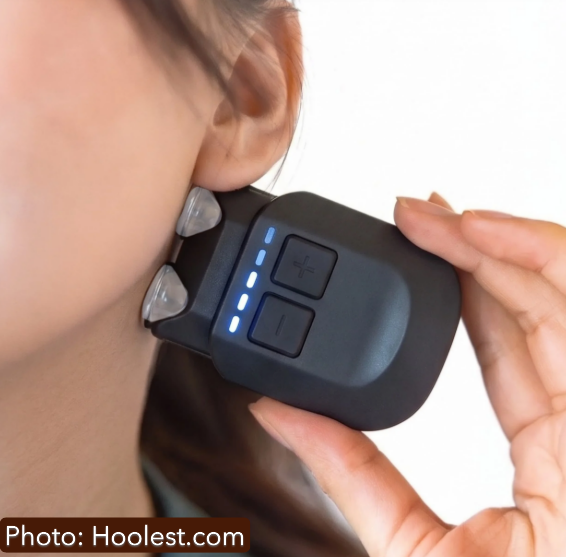
The VeRelief Prime is a handheld electrical vagus nerve stimulator. It is a small device that you hold against the side of your neck during each session. Unlike the Apollo Neuro, which delivers gentle vibration passively through a wearable band, the VeRelief Prime uses mild electrical current through gel-tipped electrodes that press directly against the skin over the vagus nerve.
The core idea is straightforward: the vagus nerve runs along the side of your neck, and placing a mild electrical current near it sends a signal up to the brain that nudges the nervous system toward a calmer state. This is a more direct approach than vibration-based devices, which work through a chain of sensory signals. Because the electrical signal reaches the nerve more immediately, the device's published research shows effects within ten minutes.
The device offers five modes: Worry, Sleep, Stress, Focus, and Panic. Each uses a different stimulation frequency. Worry uses 8Hz for calming racing thoughts; Sleep uses 25Hz; Stress, Focus, and Panic use 100Hz for more immediate intervention. Hoolest recommends five minutes on each side of the neck per session, for ten minutes total.
To conduct the electrical signal properly, the electrodes are fitted with proprietary gel tips. These are not optional. Without them making good contact with the skin, the signal cannot reach the nerve effectively.
What Actually Happened When I Used It
I used the VeRelief Prime for approximately two months. My protocol followed the instructions: five minutes on each side of the neck, using the Worry mode in the mornings and the Sleep mode before bed.
My honest experience was that the relaxation effects were mild. For most sessions, I noticed a subtle settling in my body, the kind of shift you might feel after a few slow breaths. Sometimes I noticed nothing. The device was not unpleasant to use, but it never produced the kind of clear effect I was hoping for.
The more significant issue was practical. The VeRelief Prime requires you to hold it against your neck for the full session. You cannot put it down, walk around, or do much of anything else. Each session is ten minutes of stillness with a device pressed to your neck. I already have a regular meditation and breathwork practice, so I have some tolerance for dedicated quiet time. Even for me, carving out a separate ten-minute window twice daily just for this device felt like more friction than it was worth.
The gel tip failure was the deciding factor. The device came with two pairs of gel tips, which Hoolest states last approximately 20 uses each. Mine lost conductivity after around five uses. I gave it a genuine second chance and ordered a replacement pair, which also lasted only about five sessions. When gel tips degrade, you know it: the stimulation becomes patchy or stops feeling like anything. Replacement tips cost approximately $19 per pair including shipping, or $11 per month through Hoolest's subscription. For a $399 device, the ongoing consumable cost was something I had not fully factored in, and the much shorter-than-advertised lifespan of my tips made the economics harder to justify.
I returned the device within the guarantee window, which was 60 days at the time of my purchase and has since been shortened to 30 days. Customer support was responsive and helpful throughout, both when I had questions about the gel tips and when I initiated the return. The return itself was straightforward, though shipping the device back is at the customer's expense.
The Science Behind the VeRelief Prime
The science behind electrical vagus nerve stimulation is genuinely promising, and Hoolest has invested more in research than many consumer wellness companies do. It is worth walking through what the evidence actually shows, because some context is useful.
The study Hoolest links to on their research page is a 2019 preprint from Arizona State University by Tyler, Wyckoff, Hearn, and Hool (Tyler et al., 2019). It involved 120 participants and tested electrodes that delivered stimulation through the ear canal. The results were encouraging: the approach was well-tolerated and appeared to reduce stress arousal and improve attention. It is worth noting that this study used ear-based electrodes rather than the neck-based design of the VeRelief Prime, so it is more directly relevant to Hoolest's Pro model than to the device reviewed here. It also remains a preprint and has not yet been published in a peer-reviewed journal.
Hoolest also describes two additional trials on their research page: a placebo-controlled study in 18 competitive golfers showing a 36% reduction in anxiety, and a study in 24 people with PTSD and panic disorder showing a 24% reduction in anxiety and a 31% increase in heart rate variability. These used neck-based stimulation and are the most directly relevant to the VeRelief Prime. They have not yet been published in peer-reviewed journals, which means they cannot be independently reviewed in the way published research can. This is not unusual for an early-stage company building its evidence base, but it is worth knowing.
The broader independent research on this type of electrical vagus nerve stimulation is on firmer footing. A 2024 double-blind randomized controlled trial published in Frontiers in Integrative Neuroscience found that it significantly reduced anxiety in university students compared to a sham control (Ferreira et al., 2024). A 2025 review in Frontiers in Physiology concluded that it consistently produces measurable effects, including increases in heart rate variability and reductions in stress-system activation, though findings vary across studies due to differences in electrode placement, frequency, and study design (Matsuoka et al., 2025). The underlying mechanism is real and independently supported. What remains unverified is how well the VeRelief Prime specifically performs, since no peer-reviewed published study has tested it directly.
Who the VeRelief Prime May Be Well Suited For
My experience is not the only data point that matters here. The customer reviews for the VeRelief Prime include a significant number of people reporting meaningful results, particularly those dealing with panic attacks, acute anxiety, and PTSD. The device's own research focused on those populations, and the effects in people with clinically elevated anxiety appear more robust than in people who are generally well-regulated.
If you are dealing with frequent panic attacks or episodes of acute anxiety, the VeRelief Prime's design actually makes more sense for that purpose than a passive wearable does. Holding a device deliberately during an anxiety episode is not necessarily a disadvantage in that context. It is an active, intentional tool rather than a background one.
It may also suit people who have tried breathwork and meditation and find them difficult to access during heightened states. For someone whose anxiety escalates quickly and who cannot reliably slow their breathing when it matters most, a device that does some of that work without requiring the same degree of self-regulation could be genuinely valuable.
The device is HSA/FSA eligible, which meaningfully changes the out-of-pocket cost for people with those accounts.
If hands-free, passive use is a priority for you, the Apollo Neuro is likely a better fit. It is worn on the wrist or ankle and operates in the background while you go about your evening routine, with no active holding required and no consumable parts. The tradeoff is that it uses gentle vibration rather than direct electrical stimulation, which is a less direct mechanism. For people dealing with acute, high-intensity anxiety or panic, the stronger stimulation of the VeRelief Prime may be more appropriate. For people seeking general wind-down and sleep support, the passive nature of the Apollo Neuro may be easier to sustain long-term. You can read my full experience in Apollo Neuro Review: A Psychologist Specializing in Anxiety Reviews the Apollo Neuro.
Practical Notes
The device currently retails at $399, though sales are frequent. The Stress Protection Plan at $11 per month includes monthly gel tip replacements and a lifetime device warranty. If you plan to use it consistently, that subscription math is worth doing: replacing tips out-of-pocket costs more, and the warranty matters for a device at this price.
There is no app and no Bluetooth. You select the mode directly on the device, which is a genuine advantage for simplicity and reliability.
Gel tip longevity is the biggest variable in your experience. Some users report durability close to the advertised 20 uses; others, like me, find them degrading much faster. Skin chemistry, skin preparation, and how firmly you press the device all appear to affect tip life. Hoolest recommends cleaning the skin before each session, which may help.
The device is not recommended for people with pacemakers, metal implants near the stimulation site, active skin conditions in that area, or during pregnancy. If you are working with a physician or mental health professional for anxiety or PTSD, it is worth discussing with them before adding this device to your routine.
Verdict
The science behind electrical vagus nerve stimulation is real, and the VeRelief Prime is a legitimate device in a legitimate category. The research supporting its use for acute anxiety and panic is more robust than what you will find behind many consumer wellness products.
For me personally, the combination of limited subjective effect, the hands-on time commitment, and the gel tip durability issue made it not worth continuing. I returned it.
Whether it is worth trying depends on your specific situation. For acute anxiety, panic episodes, or PTSD, the VeRelief Prime may be worth a serious look, particularly given the 30-day money-back guarantee. For general nervous system support, wind-down, or sleep, I found the Apollo Neuro a better fit. As always, a device like this is not a substitute for working with a qualified mental health professional. It is a tool that may support your nervous system alongside proper care, not in place of it.
References
Ferreira, L. M. A., Brites, R., Fraião, G., Pereira, G., Fernandes, H., Brito, J. A. A., Generoso, L. P., Capello, M. G. M., Pereira, G. S., Scoz, R. D., Silva, J. R. T., & Silva, M. L. (2024). Transcutaneous auricular vagus nerve stimulation modulates masseter muscle activity, pain perception, and anxiety levels in university students: A double-blind, randomized, controlled clinical trial. Frontiers in Integrative Neuroscience, 18. https://doi.org/10.3389/fnint.2024.1422312
Matsuoka, M., Yamaguchi, T., & Fujiwara, T. (2025). Transcutaneous auricular vagus nerve stimulation in healthy individuals, stroke, and Parkinson's disease: A narrative review of safety, parameters, and efficacy. Frontiers in Physiology, 16. https://doi.org/10.3389/fphys.2025.1693907
Tyler, W. J., Wyckoff, S., Hearn, T., & Hool, N. (2019). The safety and efficacy of transdermal auricular vagal nerve stimulation earbud electrodes for modulating autonomic arousal, attention, sensory gating, and cortical brain plasticity in humans. bioRxiv [preprint, not peer-reviewed]. https://www.biorxiv.org/content/10.1101/732529v2.full