
CalmiGo Review: A Psychologist Specializing in Anxiety Reviews a Breathing Device for Panic Attacks
By Dr. Lienna Wilson, Licensed Psychologist | Vagus Vitality
This article includes affiliate links. I may earn a commission on qualifying purchases.
Panic attacks are one of the most frightening experiences a person can have. The heart races, breathing becomes shallow and fast, and the body floods with signals that something is terribly wrong, even when nothing is. As a psychologist who works with anxious clients, I have spent years helping people find tools that work in those moments, not just in the therapist’s office.
When CalmiGo reached out to me in 2023, I was intrigued. Here was a device built around a mechanism I already believed in: extended exhalation as a direct pathway to activating the parasympathetic nervous system. I received the device, tried it, and am now ready to give it a proper review. This is what I found.
| QUICK SUMMARY | |
| What is it: | A handheld biofeedback breathing device that guides extended exhalation through light, vibration, and scent to activate the parasympathetic nervous system. |
| Best for: | People with panic attacks, acute anxiety, or PTSD-related hyperarousal who find self-directed breathwork hard to sustain under stress. |
| Not ideal for: | People looking for a passive, wearable background tool they can use throughout the day. |
| Bottom line: | The underlying mechanism is solid science. The device's value is in making slow exhalation reliably achievable in the moments when anxiety makes it hardest to do alone. |
| Price: | $218 for a 12-month plan. FSA/HSA eligible. 30-day money-back guarantee. |
| ✓ Pros | ✗ Cons |
| ✓ Grounded in well-established breathing science | ✗ Requires active use and concentration |
| ✓ Removes cognitive load during acute anxiety | ✗ Requires ongoing subscription to use the app |
| ✓ Engages four senses simultaneously for grounding | ✗ Most studies are small or lack a control group |
| ✓ Three-minute sessions are genuinely doable | ✗ Burnout benefits may take 6 weeks of regular use (does not apply to panic relief) |
| ✓ Portable and discreet | ✗ Some users may be sensitive to scents (plates are removable) |
| ✓ FSA/HSA eligible | |
| ✓ Growing research base across multiple populations |
Shop CalmiGo: https://calmigo.com/pricing-plans
Discount code: Use VAGUSNERVE at checkout for $35 off any plan.
What CalmiGo Is
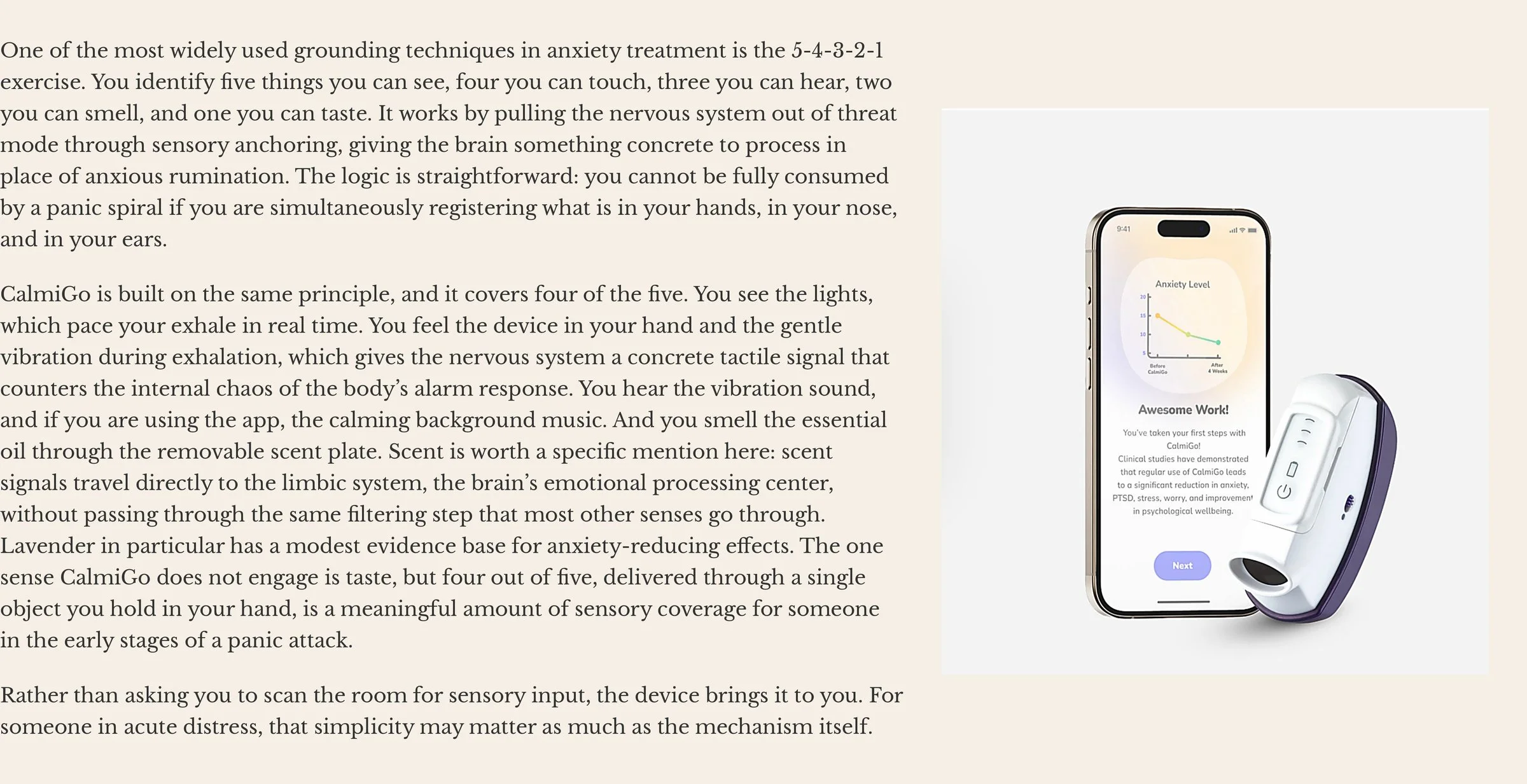
CalmiGo is a small handheld breathing device designed to guide you through slow, extended exhalation to bring on a calming response quickly. You exhale into a mouthpiece, and the device reads the length and pace of your breath in real time, providing biofeedback through light and gentle vibration to encourage you to slow down and extend your exhale. It also delivers a calming scent through a removable essential oil plate attached to the device. The scents available are lavender, peppermint, and bergamot.
The device is portable, about the size of an inhaler, and designed to be used anywhere: at your desk, on public transport, before a presentation, or in the middle of a panic attack. Each session runs three minutes.
Since I first received a complimentary CalmiGo in 2023, the company has launched CalmiGo Plus, which pairs the original hardware with a Bluetooth-connected companion app. CalmiGo subsequently sent me a complimentary Plus device, so I have now used both models. The core hardware is the same, but I will point out where my experience with the two versions differs.
My Personal Experience
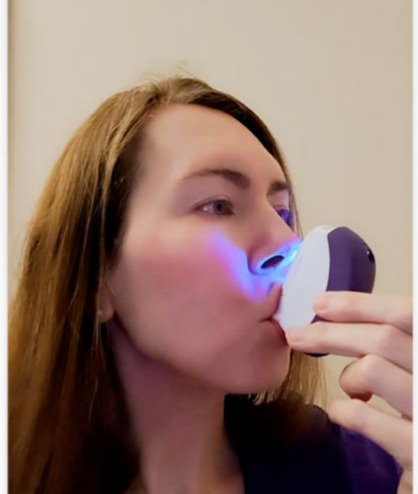
I want to be straightforward about the limits of my personal experience with this device: I do not suffer from panic attacks. My relationship with anxiety is more diffuse, the kind of low-grade overactivation that comes with a demanding professional life and a nervous system that tends to run a little fast. I cannot tell you from personal experience how CalmiGo performs in the acute, high-intensity scenario it was primarily designed for.
What I can tell you is how it performed as a general breathing support tool. In those contexts, having an external guide, something that paces the exhale for me without requiring me to count or focus, was useful. Three minutes is a short enough commitment that I actually did it.
The scent was effective. I used lavender, and found the scent grounding in an uncomplicated way. It is hard to attribute precisely how much the scent contributed versus the breathing versus simply pausing for three minutes, but the multi-sensory package felt coherent.
What I cannot personally evaluate is whether it would hold up in a high-intensity panic state, where the cognitive and physiological demands are much greater. Based on how panic attacks work, I believe the device’s design is well-suited for that scenario: the external pacing removes the cognitive load of self-directing the breath, the grounding elements give the body something physical to anchor to, and three minutes is short enough to sustain even when distressed. But that is clinical reasoning, not first-hand experience, and I want to be clear about the difference.
The CalmiGo Plus app is a meaningful upgrade to the experience. It connects via Bluetooth and plays calming background music during the session, which adds another layer of sensory support and makes the three minutes feel more contained. The app also handles the timing, so you are not watching a clock or guessing when the session ends. It includes a reminder feature that lets you schedule breathing prompts throughout the day, which I think is genuinely useful: the device is only as effective as your commitment to using it, and having a nudge at a set time reduces the friction of building a habit. There is also a gamified token system that rewards consistent sessions and encourages you to return. I am not usually drawn to that kind of engagement mechanic, but I can see how it would help people who struggle with consistency. For habit formation purposes, it adds structure without adding effort.
How CalmiGo Works: The Vagus Nerve Connection
The mechanism behind CalmiGo is not marketing language. It is grounded in well-established physiology.
The vagus nerve is the longest nerve in the autonomic nervous system, running from your brainstem through your neck, chest, and abdomen to reach your heart, lungs, and digestive organs. It is the primary conductor of the parasympathetic nervous system, the branch responsible for rest, recovery, and calm. Most signals carried by the vagus nerve actually travel from the body to the brain, and the brain adjusts its threat assessment accordingly.
Breathing is one of the most direct ways to influence that data. Specifically, the length of your exhale relative to your inhale has a measurable effect on heart rate variability (HRV), which is one of the most reliable markers of how active the vagus nerve is. When you extend your exhale, you activate a pressure-sensing reflex in the blood vessels that signals the vagus nerve to slow the heart and shift the nervous system toward calm. A long, deep exhale produces a strong calming signal to the nervous system.
CalmiGo is designed to train that exhale. Rather than asking you to count seconds and pace your own breath during a moment of acute distress (which is genuinely difficult to do when anxious), the device does the pacing for you. You exhale into it, it reads your breath, and it gives you real-time biofeedback through its lights and vibrations to guide your exhalation longer and slower than you would manage on your own. This is what distinguishes it from simply being told to breathe slowly: the feedback loop is external, which reduces the cognitive load during a difficult moment.
You can read more about slow breathing, resonance breathing, and their effects on the vagus nerve in How to Activate Your Vagus Nerve: A Science-Backed Guide to Every Method.
The Multi-Sensory Design
The Science: What the Research Actually Shows
When I first received the device in 2023, CalmiGo shared two studies with me. Since then their evidence base has grown. I will summarize what I have been able to review directly, including studies their own website has not yet listed.
The peer-reviewed study I received in 2023 is a randomized controlled trial published in a peer-reviewed journal (Rosenberg & Hamiel, 2021). Researchers assigned 34 college students with test anxiety to three groups: one using the CalmiGo device, one practicing self-directed slow breathing, and one receiving information only. Only the CalmiGo group showed significant reductions in test anxiety, stress, and negative mood. Notably, the device group also practiced more often than the breathing-only group, but the frequency of practice did not predict how much people improved, suggesting it was the guided feedback itself that made the difference, not just the time spent breathing. The study was small, and CalmiGo’s manufacturer donated devices and covered language editing costs, which is worth knowing. But the finding holds up.
The unpublished study CalmiGo shared with me looked at 29 male veterans with combat-related PTSD and anxiety (Wallach & Levin, n.d.). After four weeks of using the device three times daily, anxiety levels dropped from the moderate-severe range to mild-moderate within the first week and stayed there. PTSD symptom scores dropped by nearly 18 points, well above the 10-point threshold that researchers consider clinically meaningful. There was no control group, so we cannot rule out natural improvement over time, but the results were consistent across nearly all participants individually, not just as a group average.
A preprint study from Sourasky Medical Center tested the device in 42 oncology healthcare workers over ten weeks (Manor et al., 2023). All 42 completed the study, which is unusually high. Stress and burnout scores did not change much in the first few weeks but improved significantly by weeks six and eight. Device satisfaction also rose over time. The practical takeaway: if you try CalmiGo to help reduce burnout, give it at least six weeks before deciding whether it is working for you.
An independent 2025 randomized controlled trial from Ohio State University (Chakraborty, 2025) compared CalmiGo to written breathing instructions for abdominal bloating. Both groups improved, but the CalmiGo group reached significance sooner. This study matters less for its topic than for what it shows: an independent research team at a major university found that device-guided breathing produces measurable results beyond what written instructions alone can achieve.
The most recent results come from a study presented at a major emergency medicine conference (Ravishankar et al., SAEM26, May 2026). Thirty-five patients who came to an emergency department with anxiety or panic attack symptoms used the device three times during their visit. Panic symptom scores dropped significantly. Patients with the most severe anxiety at the start improved the most, by roughly double compared to those with milder symptoms. Patients on anxiety medication and those not on medication improved equally. This is the study most directly relevant to what CalmiGo is designed for, and the results are encouraging.
An additional study is currently underway at Abbott Northwestern Hospital in Minneapolis, examining CalmiGo in physicians experiencing burnout. This will be the first CalmiGo study to include objective measurement of physiological change rather than relying solely on self-reported symptoms, which will strengthen the evidence base if results are positive.
Across all of this, the mechanism is not in question. The science behind slow, extended exhalation and its effects on the nervous system is well-established, independent of CalmiGo’s own research (Gerritsen & Band, 2018; Lehrer & Gevirtz, 2014). CalmiGo is a tool designed to help people do something that is already known to work. That is the most important thing to understand about its evidence base.
Who CalmiGo Is Best Suited For
Based on my experience and my reading of the research, I think CalmiGo is a particularly good fit for a few specific situations.
It is likely most valuable for people who experience acute anxiety, panic attacks, or PTSD-related hyperarousal and who struggle to slow their breathing voluntarily during those states. The external biofeedback is most useful precisely when self-directed breath control is hardest. Someone whose breathing becomes rapid and shallow during a panic attack has very little capacity to count seconds and pace themselves. Having a device that does that work externally, while also providing grounding sensory input, addresses the problem from multiple angles at once.
It may also suit people who know they would benefit from a regular slow-breathing practice but find it difficult to sustain without structure. Three minutes is a short and accessible commitment. The device makes the practice concrete and portable.
The multi-sensory design, specifically the vibration and scent elements, adds grounding value beyond breathing alone. For people who work well with sensory anchoring, this may enhance the effect beyond what a breathing app or a simple pacing cue would offer.
CalmiGo is less likely to be the right fit for people looking for a passive background tool they can wear throughout the day. It requires active use during a dedicated session. If hands-free, ambient nervous system support is your primary goal, a wearable like the Apollo Neuro operates differently and may be a better match. You can read my full experience with that device in A Psychologist Specializing in Anxiety Reviews the Apollo Neuro.
As always, a device is not a substitute for working with a qualified mental health professional if you are dealing with significant anxiety, panic disorder, or PTSD. CalmiGo can be a useful tool alongside proper care. It is not a replacement for it.
One practical note on age: CalmiGo is approved for use from age six and up, which makes it one of the few anxiety tools in this space that parents of anxious children can also consider.
On side effects: there are none reported beyond the scent, which some people may find too strong or simply not to their taste. If scent sensitivity is a concern, the scented plate can be removed.
Practical Notes
The current pricing structure has changed since I received my device. CalmiGo now offers subscription plans: 12 months for $218, 24 months for $369, or a lifetime “special offer” option at $349, all of which include the device and app access. Scented plates are included with subscription plans at no extra cost. Prices are at the time of writing and subject to change. The device is FSA/HSA eligible, which meaningfully reduces the effective cost for people with those accounts.
I have reviewed both models. The original device has no app and no Bluetooth dependency. It guides each individual breath through its lights, showing you how long to exhale, but it does not signal when three minutes have passed. You will need to time the session yourself or run a phone timer alongside it. The CalmiGo Plus connects via Bluetooth to a companion app that plays calming music during the session, handles the timing for you, and includes session tracking, personalized treatment plans, and a gamified token system for building the habit of daily practice. There is also a reminder feature to prompt you at set times throughout the day. The app requires an ongoing subscription to access. CalmiGo has also recently launched a Clinician Dashboard, allowing healthcare providers to monitor their patients’ session frequency, duration, and progress directly.
One thing worth knowing: the device works on its own regardless of whether the app is available. If you leave your phone at home, or if you decide not to renew the subscription, the core breathing guidance still functions. You would just need to time the three minutes yourself.
There is a 30-day money-back guarantee at the time of writing.
Verdict
CalmiGo is built around a mechanism that genuinely works. Slow, extended exhalation activates the vagus nerve and shifts the autonomic nervous system toward calm. The device’s value is not in doing something novel, but in making that breathing pattern reliably achievable in moments when anxiety makes it hardest to do on your own.
I found it useful in lower-intensity situations, as a quick reset tool during a demanding workday. I believe, based on both the research and my clinical understanding of panic, that it would be most valuable for people dealing with acute anxiety or panic, though I cannot speak to that from personal experience.
The evidence base for the device itself is still developing, as is typical for consumer wellness technology. But the science behind slow, extended exhalation and its effects on the vagus nerve is well-established. CalmiGo is a thoughtfully designed tool in service of something that works.
Is CalmiGo Worth It?
At $218 for a 12-month plan, CalmiGo is not inexpensive. But there are a few things worth considering. The device is FSA/HSA eligible, which can meaningfully reduce the out-of-pocket cost. The 30-day money-back guarantee removes the risk of trying it. And unlike a therapy session or a prescription, it is available immediately, requires no appointment, and can be used anywhere.
If you experience panic attacks, acute anxiety, or chronic stress and have struggled to maintain a breathing practice on your own, CalmiGo is worth trying. The science behind the mechanism is solid, and the growing research base across multiple populations is encouraging. Based on the available evidence and my experience using it, I would feel comfortable recommending it to appropriate clients and friends who struggle with panic or acute anxiety.
Shop CalmiGo: https://calmigo.com/pricing-plans
Discount code: Use VAGUSNERVE at checkout for $35 off any plan.
References
Manor, A., Lavi Kitchuk, L., Raphael, A., Shpigel, S., Pelles-Avraham, S., Schaffer, T., Barilier, S., & Geva, R. (2023). The effects of a biofeedback breathing device on stress and burnout in oncology healthcare providers [Preprint]. Research Square. https://doi.org/10.21203/rs.3.rs-2966229/v1
Chakraborty, S. (2025). Comparing biofeedback device vs diaphragmatic breathing for bloating relief: A randomized controlled trial. Open Medicine, 20(1), 20251319. https://pmc.ncbi.nlm.nih.gov/articles/PMC12658723/
Gerritsen, R. J. S., & Band, G. P. H. (2018). Breath of life: The respiratory vagal stimulation model of contemplative activity. Frontiers in Human Neuroscience, 12, 397. https://doi.org/10.3389/fnhum.2018.00397
Lehrer, P. M., & Gevirtz, R. (2014). Heart rate variability biofeedback: How and why does it work? Frontiers in Psychology, 5, 756. https://doi.org/10.3389/fpsyg.2014.00756
Ravishankar, K. (2026, May 20). Using the CalmiGo device to reduce anxiety and panic symptoms in emergency department patients [Conference abstract]. Society for Academic Emergency Medicine Annual Meeting (SAEM26), Atlanta, GA. https://saem26.saem.org/event/saem26/planning/UGxhbm5pbmdfNDQyOTA0Mw==
Rosenberg, A., & Hamiel, D. (2021). Reducing test anxiety and related symptoms using a biofeedback respiratory practice device: A randomized control trial. Applied Psychophysiology and Biofeedback, 46, 69–82. https://doi.org/10.1007/s10484-020-09494-9
Wallach, A., & Levin, O. (n.d.). CalmiGo’s efficacy in the treatment of PTSD and anxiety in army veterans. Unpublished manuscript, Dendro Technologies.